


Is Janitor AI Safe for Kids? A Parent's Guide
Is Janitor AI safe for kids? The short answer is no. Janitor AI is an 18+ AI roleplay chatbot platform, and while 2026 brought the first real age-verification changes in its history, those changes only apply in a handful of countries. For parents in the US and most of Europe, the honest picture is this: Janitor AI is not built for children, and in many regions its sign-up flow still appears to rely mainly on self-declared age rather than a robust age check.
This guide covers what Janitor AI is, how the Janitor AI app and website actually work in 2026, whether Janitor AI is free, what "safe" really means on this platform, and what parents can do about it — including the privacy, data-security, and mental-health risks that most reviews skip entirely.


What Parents Should Know First
Janitor AI is not safe for kids. It is an 18+ AI roleplay chatbot platform built around user-created characters, long open-ended conversations, and optional NSFW content. Even though Janitor AI introduced regional age verification in 2026, those checks are limited to specific countries and do not create a global child-safety system.
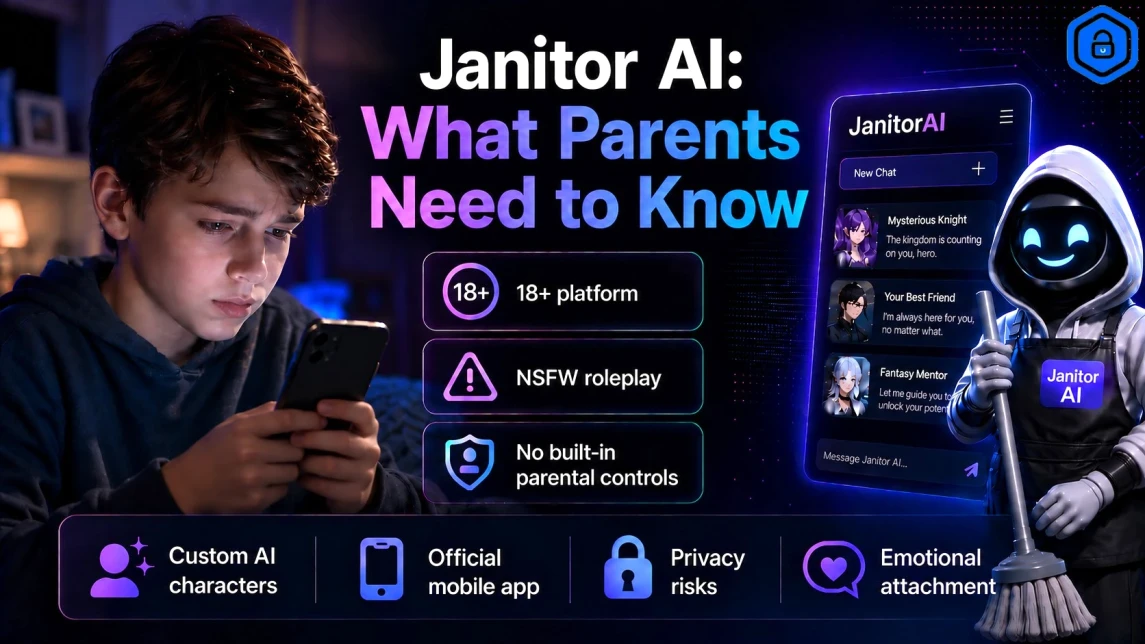
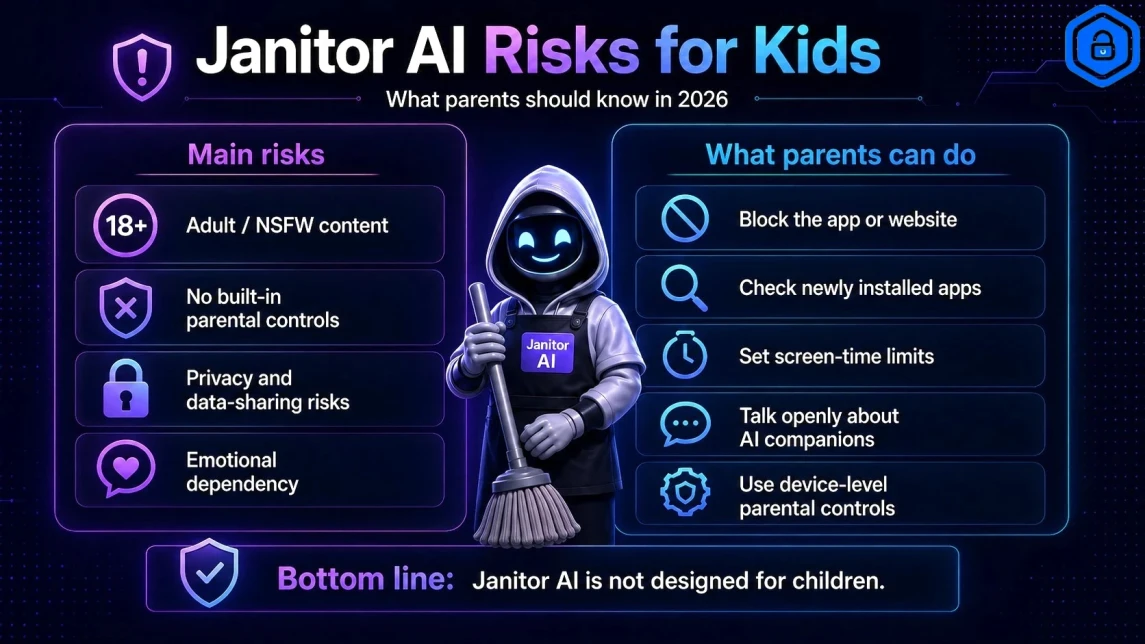
For parents, the main risks are adult roleplay content, easy access through the website and mobile app, no native parental controls, privacy risks from third-party AI providers or proxies, and the emotional pull of AI companion chats. Younger children should not use Janitor AI, and older teens need clear conversations, device-level restrictions, and careful attention to signs of overuse or emotional dependency.
The most practical approach is to treat Janitor AI as an adult platform, not as a general chatbot for teens. Parents should block or restrict access where appropriate, explain why AI companions are not real friends or therapists, and use parental control tools only as part of a broader family safety plan.
What Is Janitor AI?
Janitor AI is an AI character chatbot platform where users create and roleplay with custom AI personas. Launched in mid-2023 by Janitor AI Inc., it reportedly reached roughly a million users within its first week and has since grown into one of the largest AI companion and roleplay chatbot communities online — often described as the go-to "uncensored" alternative to Character.AI.
At its core, Janitor AI is a character-based AI chatbot: users type a message, the platform's connected language model generates an in-character reply, and the conversation continues indefinitely, shaped by the bot's persona and the user's inputs.
Janitor AI Key Features
- Custom AI characters – Anyone can build a bot with its own personality, backstory, and dialogue style in about 10–15 minutes.
- Roleplay and interactive fiction – A community hub called "The Janitorverse" positions Janitor AI as a shared storytelling space for romance, fantasy, and fan-fiction-style roleplay.
- NSFW toggle – A single setting unlocks unrestricted adult content across the platform. This is the feature Janitor AI is best known for, and the main reason it draws both loyal fans and safety concerns.
- Bring-your-own API key – This is a detail most "Janitor AI safe for kids" articles get wrong. Janitor AI is a chatbot interface, not its own AI model. It routes conversations through connected large language models — a built-in free model, a paid GPT-tier through Janitor+, or a user's own API key from an outside provider. Some users also connect unofficial "reverse proxy" services to bypass content filters on mainstream AI providers.
- Official mobile app – As of 2026, Janitor AI is no longer web-only.
Is Janitor AI Free?
Yes, Janitor AI is free to use at a basic level — creating an account, browsing characters, and chatting all cost nothing. However, the free tier runs on a lower-quality default model and has usage limits that fill up quickly. Heavier or higher-quality use typically requires either a Janitor+ subscription (for premium model access) or connecting a personal API key to a third-party provider, which comes with its own separate costs and, importantly, its own separate privacy policy. Parents should know that "free" doesn't mean self-contained — a determined teenager can still access premium-quality responses by linking an outside API key, which most parental monitoring tools won't automatically flag.
How to Use Janitor AI (And How It Actually Works)
Using Janitor AI is intentionally frictionless, which is part of what makes it easy for minors to access:
- Create an account with just an email and password (no ID, birth date verification, or parental consent in most countries).
- Browse or search the character library, or build a custom bot.
- Start chatting — the connected AI model processes the message using natural language processing to generate an in-character response.
- Optionally toggle NSFW mode on in account settings, or connect an external API key for better response quality.
The more a user interacts with a given bot, the more the conversation can reflect the established personality and context — which is exactly the mechanism that makes these AI companion chatbots feel emotionally engaging, for better or worse.
The Janitor AI App: Website vs. Mobile App in 2026
This is one of the biggest gaps in older Janitor AI reviews, most of which still describe it as a website-only platform. That's now outdated.
In 2026, Janitor AI Inc. released official mobile apps under names such as “Janitor,” “Janitor AI,” or “Janitor: Interactive Stories,” depending on the app store and region. The apps are still described as being in public beta, and parents should understand that the mobile version does not make the platform child-safe by default. A few things parents need to know about the Janitor AI app specifically:
- NSFW content is disabled by default in the app. To comply with Apple and Google's content policies, the mobile app launches in a restricted "Safe Mode": explicit bots are hidden from discovery, the AI model is tuned toward SFW responses, and explicit images are blocked.
- Safe Mode is easy to turn off. A user only needs to go to janitorai.com in a browser, open profile settings, and enable "Enable NSFW on Mobile." Once toggled on the website, the restriction lifts on the app too — no extra verification required.
- App store reviews already flag gaps. Some Google Play reviews mention being unable to fully block certain explicit content tags even within the app's restricted mode.
Bottom line: the existence of an official app does not make the platform child-safe by default. It adds a layer that looks safer on the surface, but that restriction can be bypassed by changing a setting on the website — something users may discover through online guides or community discussions.
Why Do Kids Use Janitor AI?
Before setting rules, it helps parents understand why Janitor AI can feel appealing to kids and teens in the first place.
- Creative writing and storytelling. Designing a character and "bringing it to life" appeals strongly to teens who enjoy fan fiction, world-building, or collaborative writing.
- Deep customization. Kids can shape a bot's personality, tone, and appearance, which makes the experience feel personal and creative.
- Curiosity about AI. Janitor AI offers hands-on, unrestricted access to advanced conversational AI, which is inherently interesting to tech-curious kids — a pull shared by similar AI companion apps like Talkie AI.
- Community. Large Reddit and Discord communities exist around character-sharing and bot design, and these communities are largely unmoderated with respect to the age of participants.
- The "forbidden" appeal. Compared to Character.AI, which actively restricts romantic and sexual content and has rolled out a more locked-down experience for users who self-identify as under 18, Janitor AI's reputation as the platform where "anything goes" makes it specifically attractive to teens looking for content that's blocked elsewhere.
Understanding this appeal can make it easier to talk about limits calmly, instead of framing the issue only as punishment or prohibition.
Is Janitor AI Safe? Real Age Restrictions in 2026
This is where most "is Janitor AI safe" articles are outdated, including earlier versions of this one that referenced a nonexistent "Limited mode for under-18 users." There is no such built-in age tier. Here's what's actually true.
The 18+ rule, on paper
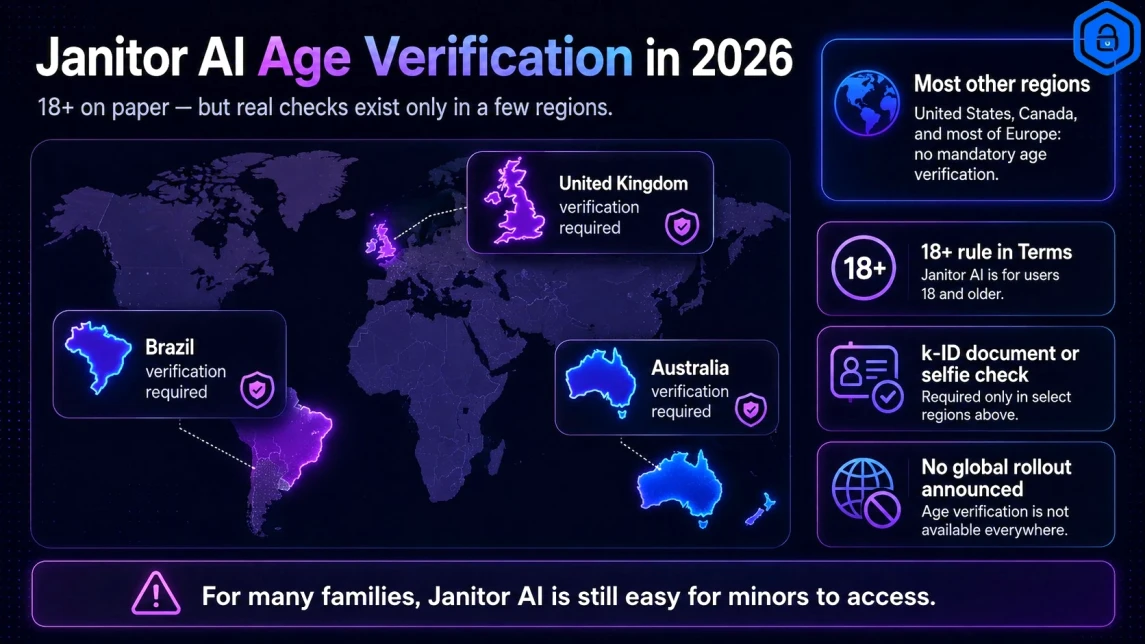
Janitor AI's terms of service and community guidelines require all users to be 18 or older, and state that any account reasonably suspected of belonging to a minor gets permanently banned. Until 2026, though, this rule existed purely on the honor system: no birth-date check, no ID upload, no email verification tied to an adult account. Anyone who could type a username and password could have an account in under a minute.
What changed: partial, regional age verification
Between April and June 2026, under legal pressure, Janitor AI rolled out mandatory age verification through k-ID — the same age-assurance provider used by Discord, Twitch, and Snapchat — but only for users connecting from specific regions:
- Australia and Brazil — required since April 24, 2026, driven by Australia's Online Safety Act age-restricted material codes and Brazil's new "Digital ECA" (Law No. 15.211/2025).
- United Kingdom — required since June 15, 2026.
- k-ID verifies age through a document or live selfie check and returns only a yes/no answer to Janitor AI — no documents or biometric data are stored by the platform itself.
- Janitor AI has stated it has no current plans to extend mandatory verification to other regions, including the United States, Canada, or the rest of Europe, framing the rollout as a legal requirement rather than a proactive safety measure.
Separately, in late April 2026, some users outside these three regions also reported being prompted to upload a face photo to continue using the platform, sparking backlash on Reddit's r/JanitorAI_Official from users unwilling to submit biometric data. Whether this reflects a wider rollout being tested or an isolated glitch is unclear, but it shows the system is actively evolving.
What this means for US and EU parents (outside the UK): unless your household is browsing from Australia, Brazil, or the UK, Janitor AI currently has no real age check. The 18+ rule is enforced on paper only.
The Janitor AI NSFW Filter, Explained
Earlier guides often describe Janitor AI's NSFW filter as something like a built-in "safe mode for minors." That's not accurate. In reality:
- The NSFW toggle has nothing to do with the user's age — it's a general setting any account can flip, regardless of who's behind the keyboard.
- It's off by default on new accounts but can be switched on in about two clicks in account settings, with no age confirmation beyond a basic checkbox.
- Moderation relies heavily on community guidelines and user reports rather than real-time automated content scanning of every message.
- Individual user-created bots can be written in ways that nudge conversations toward mature themes even when NSFW mode is technically off — a known weakness across most character-based AI chatbot platforms, not unique to Janitor AI.
Treat the NSFW filter as a content-visibility switch, not a parental control. Its effectiveness depends entirely on who has access to it.
Privacy and Data Security: What Other Guides Leave Out
This section barely exists in most Janitor AI reviews, but it matters enormously for parents.
Your data passes through more than one company
Because Janitor AI doesn't run its own language model, every message potentially travels through at least two or three separate parties: Janitor AI itself, the connected AI provider (such as OpenAI), and — if a user connects an unofficial reverse proxy to bypass content filters — the proxy operator as well. Each hop is a separate privacy policy and a separate point of potential exposure.
There's precedent for leaks through third-party proxies
Back in 2023, users of a popular unofficial Janitor AI proxy service reported that chat logs and IP addresses tied to that proxy had leaked. The breach came from the third-party proxy, not Janitor AI's own servers — a clear example of how workarounds meant to unlock "better" AI responses can actually increase a child's exposure risk.
No confirmed large-scale breach of Janitor AI itself — but the risk is structural
Unlike some competitors in the AI companion space — for example, a February 2026 leak exposed roughly 300 million messages from 25 million users of a different AI chat app after a misconfigured Firebase database — there's no confirmed large-scale breach directly attributed to Janitor AI as of September 2026. The platform states on its own safety page that staff don't read user chats and don't share them with third parties. That said, account compromise through phishing, password reuse, malicious browser extensions, or leaked API keys remains a real risk, and routing messages through external AI providers means "complete privacy" was never really on the table to begin with.
The practical takeaway
If a teen does end up using the platform, make clear that nothing typed into Janitor AI is guaranteed private or permanently deletable — no real names, addresses, school names, photos, or anything else that could identify them.
The Psychological Impact of Janitor AI on Kids and Teens
This is arguably the biggest gap in existing Janitor AI safety content, most of which focuses only on explicit content and skips how AI companion chatbots interact with a developing mind.
Parasocial attachment
Researchers describe how AI companions — including character-based bots like the ones on Janitor AI — can foster parasocial attachment: a one-sided emotional bond where a teen starts treating the bot like a real friend, partner, or confidant. Because these bots are designed to be endlessly agreeable and validating, they can create an illusion of a "perfect" relationship that doesn't prepare kids for the friction and nuance of real human connection.
Overreliance and emotional dependency
Unlike social media or gaming addiction, dependency on an AI companion is driven by dynamic, emotionally adaptive conversation — the bot mirrors the user's mood, which can make it feel more understanding than real people. Mental health professionals and organizations like the American Psychological Association have warned this can interfere with the development of healthy real-world relationships and social skills, particularly in adolescents who are less likely to critically question an AI's responses.
Poor handling of mental health crises
A well-documented risk with AI companion chatbots generally is their inability to reliably recognize a genuine mental health crisis. If a teenager hints at self-harm, anxiety, or depression, an agreeable-by-design bot may fail to escalate appropriately — or in worst cases, reinforce harmful thinking instead of directing the user toward a real person or crisis resource. This exact failure mode is central to ongoing lawsuits against other AI companion platforms (including Character.AI and OpenAI) filed by families after teen suicides linked to prolonged chatbot use — cases that are part of why the entire AI companion category, Janitor AI included, is now under regulatory scrutiny.
What experts recommend
- Talk to kids directly: an AI bot is not a person, a therapist, or a replacement for friendship, no matter how convincing or warm it sounds.
- Watch for withdrawal from real-world friendships in favor of chatbot conversations, or distress when a bot conversation is interrupted.
- If a child discloses thoughts of self-harm or suicide to an AI chatbot, treat it as urgent — contact a mental health professional or a crisis line immediately rather than relying on the app's settings.
The 2025–2026 Regulatory Landscape
Another gap in most existing guides — and the actual reason Janitor AI started changing anything in the first place.
- In September 2025, the US Federal Trade Commission opened a formal inquiry into AI companion chatbots and their effects on children and teens, sending information requests to seven major companies (Alphabet, Character.AI, Meta/Instagram, OpenAI, Snap, and xAI). Janitor AI wasn't on that list, but it operates in the exact category the FTC flagged — bots designed to "mimic human characteristics, emotions, and intentions" in ways that can prompt kids to trust and form relationships with them.
- Common Sense Media has publicly stated that AI companion apps pose an unacceptable risk to users under 18, citing exposure to sexual content and unsafe advice as core concerns.
- The TAKE IT DOWN Act was signed in 2025, and the FTC began enforcing its notice-and-takedown requirements in 2026. Covered platforms must provide a way to request removal of nonconsensual intimate images and remove valid reports, including known identical copies, within 48 hours.
- New laws in Australia, Brazil, and the UK help explain why Janitor AI introduced regional age verification in those markets. In Australia, the Age-Restricted Material Codes commenced in March 2026, and breaches of a direction to comply can carry penalties of up to A$49.5 million per breach. Brazil's Digital ECA (Law No. 15,211/2025) has been in force since March 17, 2026, with fines that can reach R$50 million per infraction. In the UK, Ofcom can impose fines of up to £18 million or 10% of qualifying worldwide revenue, whichever is greater.
The takeaway for parents: Janitor AI's age-verification rollout appears to be driven mainly by regional legal requirements rather than a single global child-safety standard. For families outside Australia, Brazil, and the UK, parents should not assume the platform's 18+ rule is backed by the same verification process. Device-level restrictions, clear family rules, and honest conversations remain important safeguards.
Does the Platform Have Parental Controls?
No. As of September 2026, Janitor AI has no built-in parental control system — no linked parent/child accounts, no parental notifications, and no account-level age restrictions beyond the honor-system 18+ rule. What exists instead:
- A self-managed NSFW toggle, controlled entirely by whoever holds the account.
- App "Safe Mode" by default, which is easily disabled via the website as described above.
- Regional age verification, active only in Australia, Brazil, and the UK.
Because the platform offers no native parental controls, parents may need to manage access at the device or network level. Tools like Kroha can help parents review installed apps, set screen-time limits for specific apps, restrict access to websites or apps such as Janitor AI where supported, and receive relevant alerts depending on the device, operating system, permissions, and settings. This adds a practical device-level layer of support, but it should still be combined with clear family rules and honest conversations.
📥 Block AI Chatbot Apps on Android with Kroha
📥 Set Up Kroha Parental Controls for iPhone
Should Parents Block Janitor AI?
For younger children, yes, without much debate. Janitor AI wasn't built for kids, officially requires users to be 18+, and its main competitive advantage in the market is unrestricted adult content. There's no compelling reason a child needs access to this specific platform.
For older teens (16–17), an outright ban may be harder to enforce in practice. If the platform is easy to access in their region, some teens may look for workarounds unless they understand why the restriction exists. A combination of honest conversation, device- and network-level restrictions, and consistent, low-pressure monitoring tends to work better than prohibition alone.
Signs Your Child Might Be Using Janitor AI
Since the platform requires no identity verification and works both as a website and an app, here's what to watch for:
- A new app on their phone called "Janitor," "Janitor AI," "Janitor AI — AI Girlfriend," or "Janitor: Interactive Stories."
- Long, frequent chat sessions in the evening, with the screen hidden when someone walks by.
- Casual mentions of "my character," "my bot," or a persona they've "built" or are "leveling up."
- Repeated visits to janitorai.com in browser history, especially in private/incognito mode.
- Familiarity with unusually technical terms for their age — "NSFW," "proxy," "API key," "jailbreak prompt."
- Visible emotional attachment to a specific AI character — distress when they can't access a chat, or a noticeable drop in interest in real-world friendships.
If several of these signs appear together, start with a calm conversation about what your child is using, why it matters to them, and what boundaries need to be in place.
7 Tips for Parents to Keep Kids Safe Around Janitor AI
If you discover that your child is interested in Janitor AI or similar AI companion platforms, start with practical safeguards rather than panic. The goal is to reduce access risks, explain why the platform is not appropriate for kids, and keep communication open.
- Use a dedicated parental control app. Tools like Kroha can help parents review newly installed apps, set screen-time limits for specific apps, restrict access to sites or apps such as Janitor AI where supported, and receive relevant alerts depending on the device, operating system, permissions, and settings. This is more practical than relying only on Janitor AI's own settings.
- Block access at the network or device level. Since Janitor AI has no dependable built-in age check in many regions, restricting janitorai.com and related apps through DNS filtering, router controls, or built-in iOS/Android parental profiles is one of the most practical safeguards.
- Set reasonable screen-time limits. Unmonitored, extended screen time is a risk on its own — and more so on platforms with a strong emotional-engagement design.
- Explain what an AI companion actually is. Be direct: it's not a person, not a friend, and not a therapist, no matter how "real" it feels.
- Check in periodically, without turning it into surveillance. Calm, regular conversations about what apps your child is using — and why — beat occasional panic-driven searches through their phone.
- Lead with dialogue, not fear-based bans. Kids who are told "no" without context are more likely to seek the platform out in secret. Explain the "why," not just the rule.
- Know where to turn in a crisis. If you find any mention of self-harm or suicidal thoughts in your child's chats, treat it as urgent — contact a mental health professional or a crisis line immediately rather than relying on app restrictions to resolve it.
The safest approach combines technical limits with honest conversations, because blocking access alone rarely teaches a child why AI companion platforms can be risky.
Safer AI Options Still Need Parental Oversight
No AI chatbot is risk-free for children or teens, and AI companion platforms are especially risky. If a teen needs an AI tool for school, creativity, or general questions, parents should prefer more moderated, general-purpose tools and still review privacy settings, age rules, and usage habits.
The options below are not "safe for kids" by default, but they generally offer stronger moderation than Janitor AI:
- ChatGPT – A more moderated general-purpose AI tool, but still one that should be used with age-appropriate rules, privacy awareness, and parental oversight.
- Google Gemini – Another general-purpose AI assistant with stronger content controls than Janitor AI, though parents should still review account settings, age requirements, and usage habits.
- Character.AI with its teen-specific experience – A more restricted alternative to adult-first roleplay platforms, but not risk-free, especially for teens who may form emotional attachments to AI characters.
Even with more moderated AI tools, parents should treat chatbot use as something that needs clear rules, time limits, and regular check-ins. No AI chatbot should be treated as a replacement for real friendship, emotional support, or professional help.
More AI App Reviews for Parents
To better evaluate the safety of other AI platforms for children and teens, see our related guides:
- Replika AI — Parent's Guide
- CrushOn AI — Parent's Guide
- Character AI — Parent's Guide
- PolyBuzz AI — Parent's Guide
- Talkie AI — Parent's Guide
These reviews offer a broader understanding of different AI chatbots and their potential impact on children.
Parental FAQ: Essential Questions About Janitor AI and Child Safety
What is Janitor AI?
Janitor AI is an AI character chatbot platform where users create custom AI personas and hold open-ended roleplay conversations, including an optional NSFW mode for unrestricted adult content.
Is Janitor AI safe?
Not for kids. It's officially an 18+ platform with real age verification active only in Australia, Brazil, and the UK. Elsewhere, including the US and most of Europe, anyone can sign up without proving their age.
Is Janitor AI safe to use for adults?
For privacy-aware adults, risk is manageable but not zero — messages route through third-party AI providers, and unofficial proxies carry documented leak history. It's reasonably safe with sensible precautions, but not a platform for sharing sensitive personal information.
Is Janitor AI free?
Yes, the core experience is free, though the free model is limited and heavier users typically pay for Janitor+ or connect their own paid API key.
How do you use Janitor AI?
Create a free account, browse or build an AI character, and start chatting. NSFW content and external API keys can be enabled through account settings.
Is there a Janitor AI app?
Yes. Official Janitor apps are available on the App Store and Google Play (currently in public beta), with NSFW content disabled by default unless synced from the website.
Does Janitor AI have parental controls?
No built-in parental controls exist. Families need third-party parental control software or device/network-level restrictions to monitor or block usage.
Conclusion
In 2026, Janitor AI is no longer a niche website — it's a major AI companion chatbot platform with millions of users, an official mobile app, and its first (partial) steps toward age verification under legal pressure in specific countries. But the core safety picture for parents hasn't changed: this is an 18+ platform whose main draw is unrestricted adult content, and outside Australia, Brazil, and the UK, there's still no reliable technical barrier keeping kids out.
For younger children, blocking access outright remains the safest option. For teens who've already encountered platforms like this, the more effective approach combines honest conversation about why an AI companion isn't a substitute for real relationships, real restrictions at the device and network level, and parental control tools that help parents understand app use and screen-time patterns without turning the process into constant surveillance.
Sources and Further Reading
- ABC News — FTC Investigating AI 'Companion' Chatbots Amid Growing Concern About Harm to Kids
- Janitor AI Help Center — Age Verification for Australia, Brazil, and the UK
- Janitor AI Help Center — FAQ: Mobile App Moderation
- Janitor AI — Community Guidelines
- American Psychological Association — Health Advisory on AI and Adolescent Well-Being
- Child Mind Institute — AI Chatbots and Teens
- The Jed Foundation — Why Your Teen Shouldn't Be Using AI Companions
- Malwarebytes — AI Chat App Leak Exposes 300 Million Messages
- FTC — TAKE IT DOWN Act Enforcement
- FTC — AI Chatbots Acting as Companions Inquiry
- eSafety Commissioner — Age-Restricted Material Codes
- Ofcom — Age Assurance Duties Under the Online Safety Act
- Brazil Ministry of Justice — ECA Digital Overview
- Brazil Presidency — Law No. 15,211/2025
Recent articles

Is CrushOn AI Safe for Teens? A Complete Parent’s Guide
Artificial Intelligence (AI) has rapidly integrated into our daily routines, transforming how we communicate, learn, and entertain ourselves. From virtual assistants like Siri and Alexa to personalized recommendations on streaming platforms, AI's presence is ubiquitous. This technological advancement offers immense benefits, enhancing efficiency and creating new opportunities. However, as AI becomes more sophisticated, its implications — especially for younger users — warrant careful consideration.
One such service is CrushOn AI, which is officially intended for adults (18+). However, teenagers often attempt to gain access to it, creating serious risks. In this guide, we will examine the dangers CrushOn AI poses to young people and outline how parents can protect their children.


When Should a Child Get Their First Phone?
Many parents ask the same question: When is the right time to give a child their first phone? There is no universal age that works for every family. Some children are ready at 9, while others may need to wait until 12 or older.
The decision depends less on age and more on maturity, responsibility, and the reason a phone is needed. Whether your child wants a device for school, staying in touch with friends, or greater independence, setting expectations from the beginning is essential.
In this guide, you'll learn how to assess smartphone readiness, choose an age-appropriate device, and establish healthy rules that balance independence with online safety.