



Telegram or Discord for Teens: Risks, Safety, and Parental Control
Choosing between Telegram and Discord for your teenager’s communication can feel tricky. Both apps offer strong social opportunities but come with distinct safety considerations you need to understand.
Telegram and Discord are widely used by teenagers, but they serve different communication models — Telegram focuses on large-scale channels and private messaging, while Discord is built around interactive communities, servers, and live conversations.


Which Is Safer for Teens: Telegram or Discord?
Neither Telegram nor Discord is completely safe for teenagers without privacy settings, clear rules, and parental guidance. Telegram usually carries higher exposure risks because of public channels, anonymous groups, and loosely moderated content. Discord carries higher interaction risks because teens can join servers, voice chats, and communities with people they do not know.
For most families, the safer choice depends less on the app itself and more on how the teen uses it. A private, well-moderated Discord server may be safer than an open Telegram channel, while strong privacy settings can reduce risks on both platforms.
Why Teens Choose Discord and Telegram
Teens face a landscape filled with social apps, but Discord and Telegram stand out for engaging group chats and rich interaction. Discord attracts those involved in gaming communities or study groups, offering a mix of real-time voice and text communication that feels like a digital hangout. Telegram, meanwhile, is popular for both casual chats and following larger communities through channels, with a straightforward style that appeals to teens looking for quick connection.
Their appeal often depends on how teenagers prefer to communicate and participate in online communities. Discord’s hands-on features suit those who want immersive group involvement, while Telegram’s mix of personal messaging and public broadcasts fits teens who value privacy yet want to explore wider interests.
Platform Overview
Discord
Discord is centered on servers—organized hubs where users join via invite links. These servers host various text and voice channels segmented by topic, role, or activity. Teens often use Discord for gaming clans, hobby groups, or collaborative learning where voice chat and live interaction enrich the experience.
The platform supports layered roles granting different permissions, which lets moderators manage participation efficiently. This structure makes it versatile but requires some guidance to navigate safely.
Telegram
Telegram works as a classic messenger but adds large group chats and public channels that anyone can join or follow. It’s known for speed and ease of use on phones, with messages synced across devices. Teens appreciate Telegram for anonymous group participation and open channels that offer instant access to news, fan pages, or local interest communities.
Its blending of private chats and public groups makes it flexible, but the anonymity can also open doors to content and connections without clear moderation.
Feature Comparison
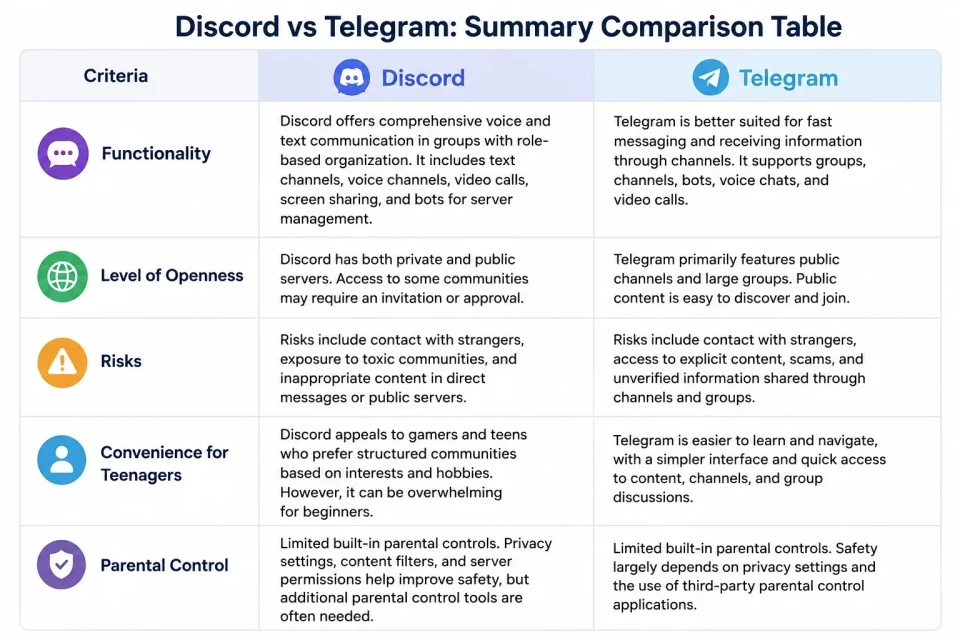
Telegram is primarily a broadcast and messaging platform, while Discord is a community-based communication platform built around servers and real-time interaction.
Communication and Convenience
- Text, voice, video — Discord supports real-time voice chat integrated with text and video; Telegram offers voice calls, video messages, and text but lacks persistent voice channels.
- Groups and channels — Discord organizes users into servers with channels; Telegram provides regular group chats and broadcast-style channels for large audiences.
- Navigation and simplicity — Telegram is more straightforward for new users due to a clean interface; Discord’s multi-layered servers and roles can feel complex initially.
Content and Communities
- Open Discord servers — Many public servers exist with varying topics, from kid-friendly to adult-focused; moderation quality varies widely.
- Telegram channels and public groups — Telegram offers vast open channels on countless topics, some anonymous and loosely moderated.
- Access to unknown users — Both allow joining groups or servers via invites or channel links, exposing teens to strangers they might not know personally.
Teen Safety in Discord and Telegram
Main Risks of Discord
- Open servers and unknown contacts — Teens can join large communities with minimal gatekeeping, increasing exposure to inappropriate behavior.
- Possibility of getting into toxic communities — Some servers foster hostile language or risky challenges that affect teen wellbeing.
- Private messages from strangers — Without strict filters, unwanted personal contact may occur unnoticed.
Main Risks of Telegram
- Anonymous channels — Users can subscribe to channels without revealing identity, making harmful content harder to trace and moderate.
- Fake groups and fraud — Scammers often create groups that mimic popular channels to deceive users.
- Exposure to unwanted content — Public channels may share material unsuitable for teens, from misinformation to graphic images.
Is Telegram or Discord Safer for Teenagers?
Neither Discord nor Telegram can be considered completely safe for teenagers without proper privacy settings and parental guidance. Discord generally offers stronger moderation tools within communities, while Telegram provides greater anonymity and easier access to public channels.
For most teenagers, the safer choice depends less on the platform itself and more on how it is used. A well-moderated Discord server may be safer than an unrestricted Telegram channel, while strong privacy settings can significantly reduce risks on either platform. Parents should focus on teaching digital safety, reviewing privacy settings, and staying involved in their child's online activities.
How to Protect a Teenager Online
Taking action early helps you build a safer environment for your child.
Focus on these key steps:
- Configure privacy settings on both apps to restrict messages and friend requests from strangers.
- Limit group or server invitations to those you approve or understand well.
- Periodically check which channels, groups, and servers your teen follows or joins.
- Initiate open conversations about digital safety and encourage your teen to share concerns.
- Set reasonable time limits for messaging apps to reduce overuse and distraction.
What Should Be Explained to a Teenager Before Registering on Discord or Telegram
Setting clear rules helps your teen navigate safely and builds trust in your guidance:
- Do not accept requests from people you don’t know personally.
- Never share personal details like phone numbers, addresses, or passwords.
- Avoid clicking on suspicious links that could lead to scams or malware.
- Do not send personal photos or sensitive information to strangers.
- Inform you immediately if any messages feel threatening or uncomfortable.
- Review and adjust privacy settings together after registration.
- Remember that online identities are not always truthful; stay cautious.

Checklist for Safe Use of Discord and Telegram for Teenagers
This checklist summarizes key safety settings and habits for parents to review with their teens:
- Enable two-factor authentication for account security.
- Restrict messages from strangers to prevent unwanted contact.
- Turn off automatic addition to groups or channels.
- Adjust privacy settings to limit profile visibility.
- Teach and review the rules of safe online communication regularly.
- Discuss your child’s online activity to stay informed and supportive.
- Use Kroha to support agreed digital rules, such as screen time limits, app usage boundaries, and safer communication habits.
Kroha can help parents understand how messaging apps are used on a child’s device, including time spent in apps and supported messenger activity. Features such as View Messenger History can provide additional context when there is a safety concern, but they should be used transparently and with age-appropriate family rules.
Helpful Resources for Digital Parenting
These guides can help parents manage screen time, reduce risky content, and set safer digital boundaries without unnecessary conflict.
- How to Disable Games on Your Child’s Phone Without Conflict
- How to limit your child's screen time on Android and iOS?
- How to Block Adult Websites on Your Child’s Phone
Frequently Asked Questions About Discord and Telegram for Teens
Is Discord safer than Telegram for teenagers?
Neither app is automatically safer. Discord usually creates more interaction risks through servers, voice chats, and direct messages, while Telegram creates more exposure risks through public channels, anonymous groups, and loosely moderated content. Privacy settings, clear rules, and parental guidance are important on both platforms.
Can parents monitor Discord and Telegram?
Parents can review privacy settings, check which communities their child participates in, and use parental control tools to better understand how messaging apps are being used. However, monitoring should be balanced with trust and open communication. The most effective approach combines parental guidance, privacy education, and age-appropriate supervision.
What age is appropriate for Discord?
Discord's Terms of Service generally require users to be at least 13 years old. Parents should assess their child's maturity and online safety awareness before allowing access.
What age is appropriate for Telegram?
Telegram is commonly used by teenagers, but younger users should only access the platform under parental guidance and with appropriate privacy settings enabled.
Is Telegram safer than Discord for teens?
Telegram may create higher exposure risks because of public channels and loosely moderated groups. Discord may create higher interaction risks because of servers, direct messages, and voice chats. Neither app is automatically safe without privacy settings and clear rules.
What are the biggest risks of Discord for teens?
Stranger contact in servers, voice chat exposure, and lack of message transparency for parents.
What is the best way to protect teens online?
The best approach is to combine open communication, privacy settings, clear rules, and age-appropriate parental control tools. Parents should know which groups, servers, or channels their teen uses and review safety settings regularly.
Conclusion
Telegram and Discord can both be useful for teenagers, but they create different safety challenges. Telegram exposes teens to public channels, anonymous groups, scams, and loosely moderated content. Discord creates more risks through real-time interaction, servers, voice chats, and contact with strangers.
The safer option depends on how your teenager uses the app, which communities they join, and whether privacy settings are properly configured. Parents should focus less on choosing a “perfectly safe” platform and more on teaching digital safety, setting clear rules, and staying involved without turning every conversation into control.
Kroha can support this process by helping families manage screen time, understand app activity, and use supported messenger safety features when needed. Combined with open communication and clear boundaries, these tools can help teenagers use Telegram or Discord more responsibly.
Recent articles

Instagram Parental Control & Message Tracking Guide
Instagram remains one of the most popular platforms among children and teens. Its visual nature, viral trends, and influencer culture make it especially appealing to younger users. With millions of active users worldwide, Instagram provides a space for creativity, self-expression, and social interaction. However, this popularity also brings significant challenges for parents concerned about their children's safety and well-being online.
In an age where digital presence is increasingly integral to social life, ensuring that children navigate Instagram safely is paramount. This article aims to help parents monitor and limit their child’s Instagram activity using built-in tools and advanced solutions like the Kroha app. By understanding the risks and utilizing effective parental control applications, parents can create a safer online environment for their children.


How to Talk to Your Teen About Parental Controls
Talking to a teenager about parental controls can quickly turn into an argument if they feel watched or mistrusted. Parents want to protect their child online, while teens want more privacy and independence.
The goal is to explain why digital boundaries exist, listen to your teen’s concerns, and agree on rules that support safety without turning parental control into punishment.
This guide explains how to start the conversation calmly, respond to resistance, and use tools like Kroha transparently and responsibly.