


Screen Time and Child Development: What Are the Risks?
Phones, tablets, computers and game consoles are now part of many children’s everyday lives. They can help with homework, creativity and staying in touch with family, but they can also crowd out sleep, movement, play and face-to-face communication when they are used too often or at the wrong time.
That is why the question is not simply “how many hours is too much?” A video call with grandparents, an educational game and two hours of short-form videos do not affect a child in the same way. Age, content, context, time of day and the rest of the child’s routine all matter.
This guide looks at the main risks of excessive screen use, what current research says about child development and how parents can build healthier device habits without turning every screen into a conflict.


What Parents Should Know First
Too much screen use can affect children when it regularly replaces sleep, physical activity, face-to-face communication, outdoor play, schoolwork or family time. The risk is usually not the device alone, but the pattern around it: what the child is doing, how long it lasts, when it happens and what other healthy activities disappear because of it.
Parents do not need to treat every screen as dangerous. Educational content, creative tools, video calls and homework can be useful. The bigger concern is unbalanced use: late-night scrolling, endless video feeds, inappropriate content, games that are hard to stop, unsafe online interactions or apps that encourage children to stay engaged for longer than they planned.
A healthier approach is usually built around simple family rules: when screens are allowed, when they stay away, which apps are appropriate and what a child should do if something online feels uncomfortable. Parental controls can support those rules, but they work best when children also understand the reason behind them.
Main Risks of Excessive Screen Use for Children
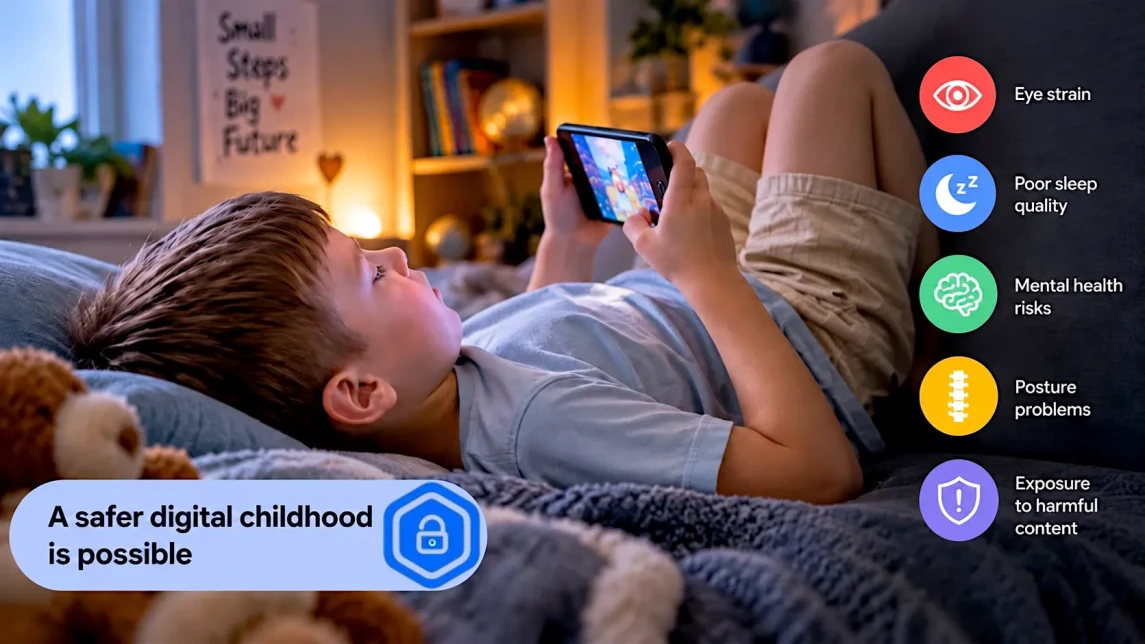
Excessive or poorly managed screen use can affect children in several ways, especially when it becomes part of daily routines without clear limits. The main areas parents should watch are sleep, eye strain, physical activity, posture, attention, emotional well-being, exposure to inappropriate content and online safety.
These risks do not mean that every device use is harmful. They mean that parents should look at the whole pattern: when the child uses screens, what they do on them, whether adults are involved, and whether screens are replacing healthier activities.
What Research Says About Screen Time and Child Development
The effect of screen use on children is more complicated than “screens are bad.” Age matters. So do the type of content, the time of day, whether a parent is involved and, perhaps most importantly, what the screen is replacing.
Recent data also show that children's digital habits are changing. According to the 2025 Common Sense Census on media use among children ages zero to eight, average screen use remains around 2.5 hours a day, but gaming has increased and short-form video has become much more common.
Sleep and Bedtime
Sleep is often one of the first things affected when a phone or tablet stays with a child late into the evening.
Digital media use has been associated with later bedtimes, shorter sleep and poorer sleep quality. Games, messages and videos can keep children engaged longer than they planned, while notifications make it easy to pick up the phone again after going to bed. The American Academy of Pediatrics' current review of children's digital media use recommends paying particular attention to media use around bedtime and to devices kept in children's bedrooms.
For families, the practical response can be simple: make the last part of the evening screen-free when possible and charge phones outside the bedroom.
Eyes, Movement and Posture
Long sessions with a smartphone or computer usually mean two things at once: prolonged near viewing and less movement.
A large systematic review of digital screen time and myopia found that greater daily screen exposure was associated with higher odds of myopia. This does not mean that screens are the only cause — genetics, outdoor time and other factors matter too — but regular breaks and time outdoors are sensible habits.
The physical side matters as well. A child who spends hours bent over a phone may experience neck, shoulder or back discomfort. Rather than focusing only on the device, parents should also look at the whole daily routine: movement, outdoor play, exercise and how long the child sits without a break.
Language, Attention and Learning
Screens can support learning, but they can also compete with the experiences children learn from best.
Young children build language through real back-and-forth communication. They hear something, respond, watch another person's reaction and adjust. A video cannot always reproduce that process.
Attention is similarly nuanced. A laptop used for homework is useful. The same laptop becomes distracting when homework competes with messages, games, YouTube and notifications every few minutes.
Instead of treating every screen as harmful, parents can create regular periods when children play, talk, read or study without constantly switching between apps.
Not All Screen Time Is the Same
Counting hours alone does not tell parents very much about what a child is experiencing.
An hour-long video call with grandparents, an educational game, homework, TikTok scrolling and watching violent content are all “screen time,” yet their developmental value and risks are very different.
The American Academy of Pediatrics now advises families to look beyond a single screen-time number and consider the child, the content, the context in which media is used and what other activities it may be pushing out.
Content and Context Matter
One of the clearest findings from recent research is that how a screen is used matters.
A 2024 systematic review and meta-analysis of screen use in early childhood found associations between age-inappropriate content and poorer psychosocial outcomes. Background television was associated with poorer cognitive outcomes, while using screens together with caregivers was associated with better cognitive outcomes.
That gives parents a more useful strategy than simply watching the clock.
Ask what the child is watching. Sit with younger children from time to time. Talk about the characters, choices and ideas on screen. If nobody is watching the television, turn it off rather than leaving it running in the background.
Parents' own habits matter too. If dinner is supposed to be phone-free, the rule works better when adults follow it as well.
Watch What Screens Are Replacing
Two children can both spend two hours with a tablet and have very different routines.
One may have already slept enough, played outdoors, finished schoolwork and spent time with friends. The other may have skipped exercise, rushed homework and stayed awake late.
This is sometimes described as crowding out. The problem is not only the minutes spent online but the healthy activities that gradually disappear because of them.
Look at the child's whole day:
- Is there enough sleep?
- Is there time to move and play?
- Are school responsibilities being completed?
- Does the child still have offline hobbies?
- Is there regular contact with family and friends away from screens?
If those parts of life are disappearing, reducing or reorganizing screen use makes sense.

New Digital Risks Parents Should Know About
Children's digital environment has changed. Online safety is no longer only about blocking adult websites.
Children can encounter cyberbullying, scams, strangers, misleading information, manipulative advertising, in-app purchases and content that algorithms repeatedly recommend because it keeps them watching.
Why Some Apps Are Hard to Put Down
Many popular platforms have few natural stopping points.
Infinite scrolling offers another post immediately. Autoplay launches the next video. Games use streaks, rewards, badges and limited-time events. Notifications pull the child back after they have already left.
The AAP's guidance on digital ecosystems specifically discusses features such as autoplay, infinite scroll, algorithmic feeds and behavioral rewards because they can encourage prolonged engagement.
This is worth explaining to children. Difficulty putting a phone down is not always simply a matter of poor discipline.
Parents can create stopping points that the app does not: disable unnecessary notifications, use app limits, keep devices away during homework and meals, and avoid keeping entertainment apps within reach at bedtime.
Privacy, Strangers and AI Chatbots
Children also need to understand that online actions leave information behind.
They should know not to share passwords, addresses, school details or private photos with strangers. They should recognize suspicious requests and know that an adult needs to be told when an online interaction makes them uncomfortable.
AI adds another layer. Children now encounter chatbots and AI companions that can answer questions, help with homework or imitate human conversation. These tools can be useful, but they can also provide inaccurate information or encourage users to share personal details.
UNICEF guidance on AI and children emphasizes children's safety, privacy, transparency and well-being when AI systems are designed or used.
Parents do not need to ban every AI tool. They do need to know which ones their child uses and what the child uses them for.
When Screen Use Becomes a Problem
A child who enjoys games or spends a long evening chatting with friends does not automatically have an addiction.
A better warning sign is whether digital media repeatedly interferes with normal life. The AAP describes problematic media use as risky, excessive or compulsive use that results in physical, emotional, social or functional problems.
Parents should pay closer attention if a child:
- regularly loses sleep because of games, videos or social media;
- gives up hobbies, sport or time with friends;
- has worsening school performance;
- repeatedly hides or lies about device use;
- cannot stop despite agreed limits;
- becomes involved in serious conflicts around devices;
- continues using an app even when it is clearly making them feel worse.
One difficult weekend does not mean there is a disorder. Look for a persistent pattern.
If screen use is seriously affecting sleep, school, relationships or emotional well-being and changes at home are not helping, it may be worth discussing the situation with a pediatrician or mental-health professional. Sometimes anxiety, stress, ADHD, depression or social difficulties can sit behind excessive screen use rather than the device being the only problem.
How to Manage Children’s Screen Time in a Healthy Way
The first step is not punishment, but a predictable routine. Children are more likely to follow screen rules when they understand when devices are allowed, when they need to be put away and why the limits exist.
Parents can start with a few practical rules:
- keep phones and tablets out of the bedroom at night;
- create screen-free times, such as meals, homework and the last part of the evening;
- turn off unnecessary notifications;
- choose age-appropriate apps, games and videos;
- watch or play together with younger children sometimes;
- use app limits or website restrictions when rules are hard to maintain manually;
- review the rules as the child grows.
These rules do not have to be perfect from the first day. It is normal to adjust them as the child grows, school routines change or new apps appear.
Parents can also follow practical strategies to limit children’s mobile time and create healthier routines after school.
Parental controls can help apply limits more consistently, but they work best when children also understand the reason behind the rules. The goal is not to remove technology completely, but to help children build habits they can eventually manage on their own.
How Kroha Can Support Healthier Screen Habits
A parental control app like Kroha can help families apply screen-time rules more consistently. Depending on the device, operating system, permissions and setup, parents can set app limits, create device schedules, restrict access to inappropriate websites where supported and review general usage patterns when they need to understand how a child is using a device.
Kroha should not replace conversations about online safety or healthy habits. It works best as a support tool for rules the family has already explained: when devices can be used, which apps are appropriate, what should stay private online and when a child should ask an adult for help.
More Guides for Parents
If you want to go a little deeper, these guides cover some of the most common screen-time and device questions parents face.
- Kids Using Phones at Night: How to Limit Screen Time. If your child keeps reaching for the phone after bedtime, this guide explains what may be behind the habit and how to make evenings less screen-heavy.
- How to See Which Apps Your Child Is Using. A practical guide to checking which apps your child actually uses and spotting anything that may need a closer look.
- How to Set Up Parental Control on Your Child’s Phone. Step-by-step instructions for setting up screen-time limits, app restrictions, and other parental controls on Android and iPhone.
These guides can help with the next step, whether the issue is bedtime, app use, or setting clearer rules on the device.
Frequently Asked Questions About Screen Time and Child Development
Can Too Much Screen Time Affect Child Development?
Yes, especially when screen use regularly replaces sleep, physical activity, face-to-face communication, play or learning. Research has found associations between some patterns of screen use and sleep, language, attention, physical health and psychosocial outcomes. The effects depend heavily on the child's age, the content and the way the device is used.
How Much Screen Time Is Appropriate for a Child?
There is no single limit that fits every age and every situation. For young children, the World Health Organization recommends very limited sedentary screen time: none for 1-year-olds and no more than one hour a day for children aged 2 to 4, with less being better. For older children, current pediatric guidance places more emphasis on healthy balance, content and whether media displaces sleep, exercise, schoolwork or relationships.
Is All Screen Time Bad for Children?
No. A video call, homework, creating digital art or watching age-appropriate educational content with a parent is different from hours of passive scrolling. Content, purpose, age and whether adults engage with younger children all matter.
What Are the Signs That a Child Is Spending Too Much Time on Screens?
The clearest warning signs are not a particular number of hours but changes in everyday life: lost sleep, falling grades, giving up hobbies, less contact with friends and family, secrecy about device use or repeated inability to stop despite negative consequences.
Can Parental Controls Replace Talking to a Child About Online Safety?
No. Parental-control tools can help parents manage apps, screen time and access to inappropriate content, but they cannot prevent every risky conversation, scam or new online trend. They work best alongside open communication, clear family rules and age-appropriate digital education.
Conclusion
Screens are already part of children’s lives, so the goal is not to make technology disappear. What parents can do is help children build habits they can use as they grow: recognizing when a screen is helpful, when it is getting in the way, what information should stay private and when they need to ask an adult for help.
Recent articles

Is CrushOn AI Safe for Teens? A Complete Parent’s Guide
Artificial Intelligence (AI) has rapidly integrated into our daily routines, transforming how we communicate, learn, and entertain ourselves. From virtual assistants like Siri and Alexa to personalized recommendations on streaming platforms, AI's presence is ubiquitous. This technological advancement offers immense benefits, enhancing efficiency and creating new opportunities. However, as AI becomes more sophisticated, its implications — especially for younger users — warrant careful consideration.
One such service is CrushOn AI, which is officially intended for adults (18+). However, teenagers often attempt to gain access to it, creating serious risks. In this guide, we will examine the dangers CrushOn AI poses to young people and outline how parents can protect their children.


When Should a Child Get Their First Phone?
Many parents ask the same question: When is the right time to give a child their first phone? There is no universal age that works for every family. Some children are ready at 9, while others may need to wait until 12 or older.
The decision depends less on age and more on maturity, responsibility, and the reason a phone is needed. Whether your child wants a device for school, staying in touch with friends, or greater independence, setting expectations from the beginning is essential.
In this guide, you'll learn how to assess smartphone readiness, choose an age-appropriate device, and establish healthy rules that balance independence with online safety.